




The bigcommerce vs shopify decision is harder now because sellers are no longer choosing only a storefront. They are choosing the operating layer that will govern B2B pricing, creator traffic, Amazon measurement, content reuse, and expansion into new channels. Creator ad spend is still rising, and shoppers increasingly expect product pages to include real customer photos and videos, which raises the cost of picking a platform that is easy to launch but expensive to scale.
For eCommerce sellers and influencers, the smarter question is not which brand wins the loudest comparison page. It is which system keeps margin, workflow, and attribution readable as your catalog, channel mix, and content program get more complex. This guide breaks the choice down with a practical decision sequence, a measurement model, and a switching-cost lens that most platform comparisons skip.
Key Takeaways
- Shopify usually wins when speed, experimentation, and app availability matter most, because its app marketplace exceeds 16,000 apps and its B2B tools can run in a blended B2B and D2C setup.
- BigCommerce usually wins when multi-storefront control, payment flexibility, and complex B2B workflows matter more than a giant app layer.
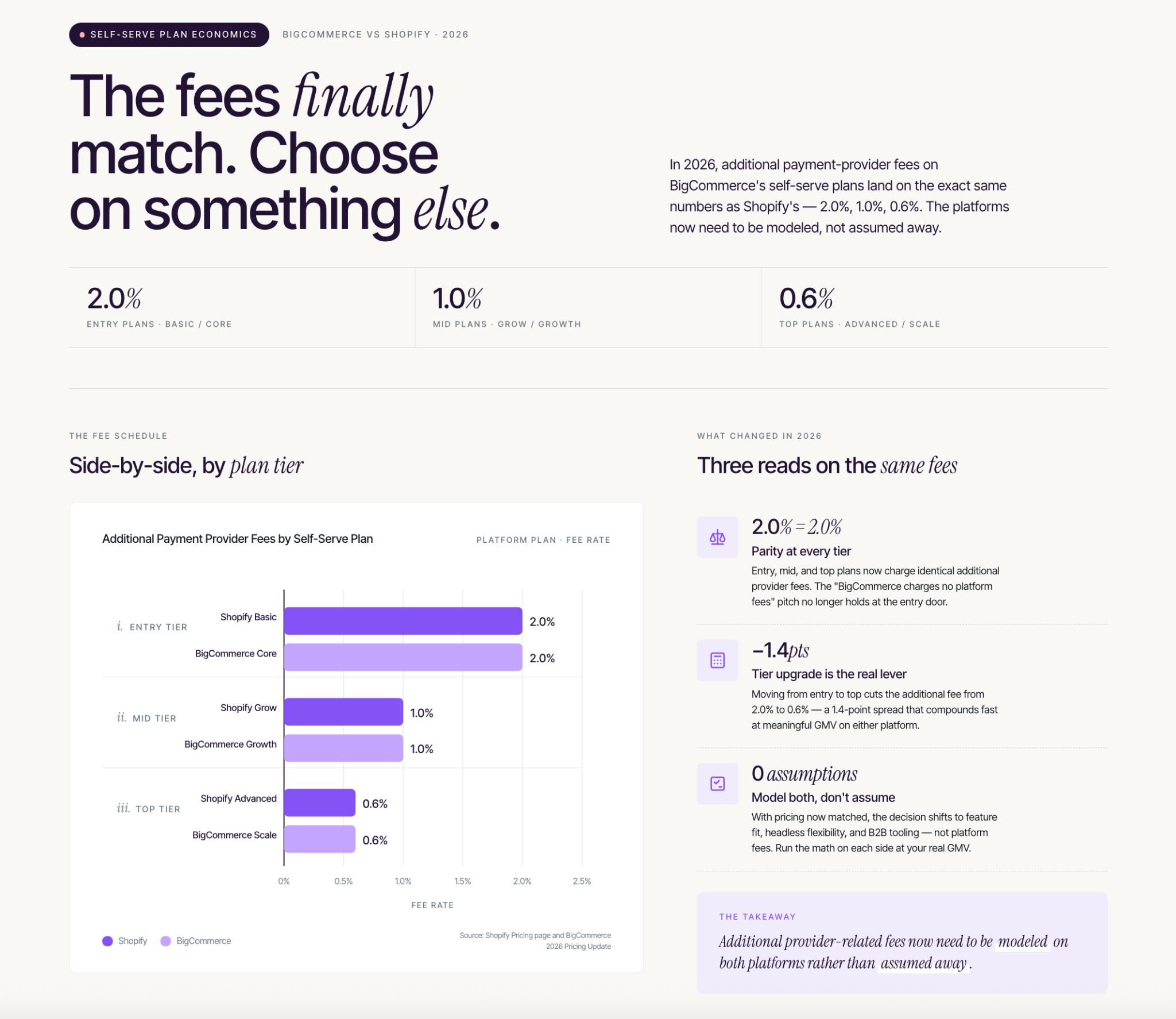
- Cost modeling in 2026 needs more than sticker price, because Shopify still applies third-party provider fees and BigCommerce has posted Open Payment Provider fees for self-service plans effective after June 1, 2026.
- If Amazon sellers or influencers are part of the growth plan, measure with a layered stack that combines store revenue, Amazon Attribution, Brand Referral Bonus, and asset reuse value from creator content.
How to Use the Store-Fit Sequence for BigCommerce vs Shopify

The fastest way to answer bigcommerce vs shopify is to stop comparing feature lists in isolation. The better move is to run each platform through the same operating test, which is what the Store-Fit Sequence is for.
The Store-Fit Sequence works because it forces a seller to compare architecture against real workflow pressure. That means catalog structure, payment economics, channel mix, and measurement setup all get weighed before a migration becomes expensive.
- Map catalog complexity. If you want one store that can handle both B2B and D2C, Shopify offers that path natively. If you need multiple storefronts, more explicit buyer segmentation, or deeper B2B workflow controls, BigCommerce deserves a harder look.
- Price the payment stack. Shopify applies third-party provider fees on alternate gateways, while BigCommerce has published Open Payment Provider fees for self-service plans starting after June 1, 2026. Neither platform should be treated as fee-free without checking your actual processor mix.
- Audit extension risk. The [Shopify App Store](https://apps.shopify.com/?utm_source=chatgpt.com) gives merchants more than 16,000 ways to extend the store, which is excellent for fast experimentation but can grow app sprawl. BigCommerce tends to matter more when you prefer deeper commerce functionality before layering on additional software.
- Score expansion plans. If your roadmap includes multiple brands, regions, buyer types, or channel-specific storefronts, BigCommerce’s multi-storefront architecture is a meaningful advantage. If your priority is a lean operator launching campaigns quickly from one core storefront, Shopify often feels lighter.
- Test measurement before migration. If influencer traffic, Amazon sellers, or an Amazon storefront strategy matter, measure how easily each setup can support clean attribution tags, reusable PDP assets, and cross-channel reporting. A store that cannot track creator traffic clearly will make profitable channels look optional.
Run the Store-Fit Sequence against the next two years of your business, not the last two months. Sellers who do that usually discover that the wrong platform is rarely unusable on day one, but it becomes painfully obvious when they add B2B rules, marketplace traffic, or creator-led growth.
What Is BigCommerce vs Shopify Really Comparing?
At a practical level, bigcommerce vs shopify is a comparison between two different philosophies of commerce infrastructure. One leans harder into built-in operational depth and open integrations, while the other leans harder into speed, ecosystem leverage, and merchant-friendly extensibility.
That distinction matters because most sellers do not fail on homepage design. They fail when catalog logic, payment rules, content operations, and attribution start colliding across DTC, wholesale, and Amazon. If your roadmap already includes those layers, the comparison is less about appearance and more about operating model.
- Shopify is ecosystem-first. Shopify positions B2B as native functionality and lets merchants run blended or dedicated B2B stores, then extend behavior through a very large app layer.
- BigCommerce is operations-first. BigCommerce emphasizes multi-storefront growth, B2B buyer controls, headless flexibility, and connecting systems without rebuilding the whole stack.
- The real decision is workflow fit. If your team wants fast experimentation and is comfortable managing app-level complexity, Shopify usually feels better. If your team wants tighter control over storefront segmentation and B2B buying structures, BigCommerce often earns its complexity.
If your broader growth plan also includes Amazon, the companion Stack Influence guide to is useful because it frames your storefront as part of a wider channel system rather than a stand-alone site. That is the right mental model for modern DTC brands that split demand capture across site, marketplace, and creator-led traffic.
When Does BigCommerce Pull Ahead for Complex Commerce?
BigCommerce becomes the stronger option when the commerce problem is operational before it is creative. That usually means multiple storefronts, regional complexity, heavier B2B requirements, or a payment stack that cannot be forced into one preferred processor.
The live comparison is especially important in 2026 because legacy “no extra fee” assumptions are no longer enough. As of May 7, 2026, BigCommerce’s live pricing page still shows Standard, Plus, and Pro at $39, $105, and $399 per month, but the company’s posted pricing update says self-service plans will move to Core, Growth, and Scale and apply Open Payment Provider fees after June 1, 2026.
- Multi-storefront control. The says merchants can create distinct storefronts for audiences, regions, and segments from one dashboard, including unique domains, currencies, pricing, and templates. That is useful when one-brand simplicity is no longer realistic.
- B2B workflow depth. BigCommerce’s B2B materials emphasize buyer portals, quotes, invoices, approval workflows, and headless support, which better matches manufacturers, distributors, and hybrid wholesale brands.
- Provider flexibility. The says the platform supports more than 65 pre-integrated payment solutions across 150-plus countries and over 140 currencies, which matters for merchants that cannot standardize on one narrow gateway set.
- Better fit for segmented growth. If your store will serve different price lists, currencies, buyer types, or branded storefronts, BigCommerce’s structure reduces the need to force that complexity into a simpler single-store model.
This is also where Amazon-oriented brands should think beyond checkout alone. If your DTC site supports product education while Amazon FBA handles part of fulfillment or trust-driven conversion, the related Stack Influence page on [Amazon solutions](https://stackinfluence.com/marketplace-solutions/amazon?utm_source=chatgpt.com) is a useful reminder that your commerce stack has to coordinate paid traffic, creator traffic, and marketplace revenue at the same time.
BigCommerce is not automatically the better enterprise answer. It is the better answer when complexity is native to your business, not when complexity is aspirational. If your store is still a fairly straightforward DTC catalog, BigCommerce can feel heavier before its advantages start paying you back.
Why Does Shopify Win on Speed, Apps, and Creator-Friendly Execution?
Shopify usually wins when the priority is fast execution across merchandising, campaigns, and content operations. That advantage comes from software abundance and a store model that lets small and mid-market teams move quickly without treating every change like a systems project.
That speed matters more than many comparison pages admit because modern growth depends on constant asset testing. The [PowerReviews visual UGC report](https://www.powerreviews.com/research/ugc-visual-content-shopper-behavior-survey/?utm_source=chatgpt.com) shows 61% of shoppers are much more likely to buy when reviews include photos and videos, and 23% will not purchase if user-generated imagery is missing.
- App-first experimentation. Shopify’s massive extension layer makes it easier to add subscriptions, bundles, creator widgets, UGC galleries, landing-page tools, and retention software without waiting on deep implementation work. Stores with requirements outside the standard catalog typically use Shopify app development services for custom functionality.
- Blended operating model. The [Shopify B2B documentation](https://help.shopify.com/en/manual/b2b?utm_source=chatgpt.com) says merchants can use one store for both B2B and D2C or split into a separate B2B-only store, which is attractive for teams trying to preserve speed while still adding wholesale capability.
- Creator-friendly merchandising. The found 81% of marketers say visual UGC resonates more than professional photography or influencer content, and 85% say it reduces content costs. That puts a premium on platforms that let teams test assets quickly.
- Better fit for campaign-heavy DTC brands. If your roadmap depends on creator traffic, paid social, quick landing pages, and frequent offer testing, Shopify often reduces time-to-test.
This is where Stack Influence’s content lens matters. Based on Stack Influence’s work with eCommerce brands, creators who deliver one in-use product shot and one honest verdict clip tend to earn about 18% more repeat invitations than creators who submit only a polished hero image, which is another way of saying useful variation beats cosmetic polish.
If that is your growth style, the Stack Influence pages on , , and are relevant because they all point in the same direction: the store that wins is the one that can turn creator assets into PDP updates, ad variations, and channel-specific content without operations slowing down the feedback loop.
Shopify’s tradeoff is that speed can hide complexity instead of removing it. App volume is powerful, but it also means operators need a real policy for stack sprawl, recurring fees, and who owns each integration once the store matures.
Should You Measure Channel and Creator ROI With a Revenue Signal Stack?
Most sellers under-measure platform fit because they only compare subscription cost and checkout output. That misses the parts of commerce that now drive margin, especially creator-sourced traffic, Amazon sellers, and reusable content assets that keep earning after the original post.
The better model is a tiered signal system that tracks sales, attribution, and asset reuse together. That is what the Revenue Signal Stack is built to do.
Revenue Signal Stack
Use the Revenue Signal Stack to separate immediate revenue from supporting signals. A platform that looks cheaper on paper can become more expensive if it muddies attribution or slows the reuse of creator content across PDPs, email, and marketplace surfaces.
What Sits in Layers One and Two?
- Layer One, platform-native revenue. Track conversion rate, average order value, contribution margin, repeat purchase rate, and channel-level CAC on your owned storefront. This is the base layer that tells you whether the store itself is converting demand efficiently.
- Layer Two, off-platform attribution. The [Amazon Attribution page](https://advertising.amazon.com/solutions/products/amazon-attribution?utm_source=chatgpt.com) says the tool is a free measurement solution for non-Amazon channels, including affiliate and influencer campaigns. The [Brand Referral Bonus page](https://sellercentral.amazon.com/help/hub/reference/external/GL9HPJ34VBFP76HX?utm_source=chatgpt.com) says brands can earn a bonus from non-Amazon marketing efforts, which means cleaner attribution can directly change margin, not just reporting.
Amazon also gives creators a direct commerce surface. Its help documentation says the Amazon Influencer Program gives qualifying creators their own presence on Amazon plus a vanity URL, which is why brands should treat creator traffic and storefront traffic as measurable commerce signals rather than vague awareness.
Layer Three Values Asset Reuse
Layer Three tracks whether creator content becomes an asset library or dies as a one-post campaign. Count approval rate, speed to deploy, PDP usage, email reuse, paid social reuse, retailer syndication, and marketplace deployment as real value drivers, not vanity extras.
Data from Stack Influence’s micro influencer campaigns suggests that campaigns tagged before product ships produce cleaner reporting than campaigns that add tracking after content is already live, which matches Amazon’s own logic that attribution works best when channel structure is clear before distribution begins. If your team needs a practical companion, Stack Influence’s guide to shows how to connect platform revenue, creator cost, and Amazon-oriented measurement into one operating view.
Platform Regret Starts With the Switching Cost Curve
Most platform guides talk as if the risk lives inside plan pricing. In practice, platform regret usually starts with the switching cost curve, which is the moment when creative workflow, catalog logic, and channel reporting become so entangled that a “better” platform is still too painful to adopt.
That hidden cost is rising because creator commerce is no longer a side channel. Influencer marketing remains a large and growing budget line, which means every lost month of messy attribution or delayed content reuse carries a bigger opportunity cost than it did a few years ago.
- Stage one, optimism. A seller chooses the platform that launches fastest or sounds most flexible.
- Stage two, workaround buildup. Apps, custom rules, and manual reporting start multiplying as B2B, DTC, Amazon, and influencer traffic all demand different logic.
- Stage three, migration debt. Replatforming now means moving products, customer structures, content workflows, permissions, tags, and analytics conventions at the same time.
Across campaigns managed on the Stack Influence platform, brands that deploy approved creator assets to Amazon product pages or Storefront destinations within 14 days of approval reportedly see first attributable orders about 19% sooner than teams that leave those assets sitting in a backlog. That is a switching-cost lesson in disguise, because the expensive part is often not making content. It is failing to operationalize it fast enough.
This is why rights and reuse planning belong in the platform conversation before launch. The Stack Influence guide to is useful here because it treats creator assets as business infrastructure, not social decoration. Sellers who understand that earlier usually make a better bigcommerce vs shopify choice because they stop choosing for launch week and start choosing for operational compounding.
Choose for the Next Two Years, Not the Next Two Weeks
The right bigcommerce vs shopify answer depends on whether your business is constrained by complexity or constrained by speed. If you run a lean DTC catalog and grow through fast iterations, Shopify is often the cleaner path. If your roadmap already includes multi-storefront expansion, deeper B2B rules, segmented buyer experiences, or more demanding payment flexibility, BigCommerce can prevent a more painful migration later.
Use the Store-Fit Sequence, validate your payment economics, and measure with the Revenue Signal Stack before you move. The platform that wins is the one that keeps your catalog, creator workflow, and attribution readable as you grow, so every new campaign adds leverage instead of operational drag.