



Substack for ecommerce sellers makes sense when your business has something people want to read beyond product announcements. A founder's perspective, practical expertise, or a well-reported account of how things are made can give a publication a reason to exist alongside your store.
The decision starts with what you intend to publish. Substack can be an editorial home, while your storefront handles purchases and your commerce email tools handle customer campaigns. Before launching, define the publication's promise, confirm how people will subscribe, and budget the work required to keep that promise.
Key Takeaways
- Give readers a reason to subscribe that stands on its own, even when they are not shopping.
- Keep checkout, order management, and purchase-triggered marketing in your commerce systems.
- Invite people to the publication explicitly instead of treating every customer email address as a subscriber.
- Evaluate publishing capacity, reader response, and commercial economics separately. A large list does not establish profitable growth.
Is Substack a Good Fit for Your Ecommerce Business?
Substack can fit an ecommerce business that can sustain an editorial publication. Its Content Guidelines prohibit publications mainly devoted to external-product advertising, traffic generation, promotions, or SEO, and say brands may face additional verification. The same guidelines require imported subscribers to have explicitly opted in to the specific publication.
That makes the publication concept your first decision. A cookware seller could publish interviews about home cooking, explanations of cooking techniques, and stories about regional food traditions. A sequence of discount codes and new-arrival announcements belongs in the seller's promotional email program.
Before opening an account, answer three questions:
- What would someone gain from reading an issue without buying anything?
- What experience, access, or perspective can your team contribute consistently?
- Who will research, write, edit, and respond to readers?
Specific answers are more useful than a broad ambition to build community. For example, a hypothetical ceramics brand might promise two monthly letters about everyday table rituals, craft, and caring for objects. That promise gives the editor a basis for choosing stories and gives the reader a clear expectation.
There are documented examples of this approach. In Shopify's guide to starting a small-business Substack, Ghia founder Melanie Masarin describes Night Shade as a personal creative outlet encompassing interests beyond the beverage brand. The useful lesson is the editorial scope, not an assumption that another store will achieve the same audience or sales.
If nobody can own the publication, choose a smaller commitment. A guest contribution or carefully evaluated newsletter sponsorship may be more practical than maintaining your own editorial schedule. Buying a placement and running a publication are different projects with different costs.
How Substack Fits Alongside Your Store
Give each system a defined job before connecting anything.
- Publication: Essays, interviews, useful explanations, reader discussion, and the relationship with people who subscribed to that editorial promise.
- Storefront: Product information, stock availability, checkout, payments, fulfillment, and returns.
- Commerce email system: Customer segments, promotional campaigns, and messages triggered by shopping or purchasing behavior.
For example, Shopify documents marketing automations in Shopify Messaging for abandoned browsing, carts and checkouts, post-purchase messages, and customer winback. Keep those workflows connected to the commerce data they need.
Substack does have automated messages. Its welcome-email settings support different introductions for free, paid, imported, and founding subscribers. That subscriber-based functionality serves a different purpose from a message triggered by an uncompleted order.
A shop link also has a limited job: taking someone to the shop. It does not by itself synchronize orders, inventory, customer records, or consent between systems. Before relying on any connector, check which events it transfers, how unsubscribes are handled, and whether the workflow actually works in your accounts.
What Does Substack Cost an Ecommerce Seller?
Substack's published pricing states that publishing is free regardless of subscriber count. If you enable paid publication subscriptions, Substack takes 10% of subscription revenue, with applicable Stripe fees added. The documented Substack fee for connecting a custom domain is a one-time $50; account for domain registration separately.
For a free brand publication, editorial labor deserves its own budget even when the publishing fee is zero. Decide who does the work and how much time the business can allocate before promising a cadence.
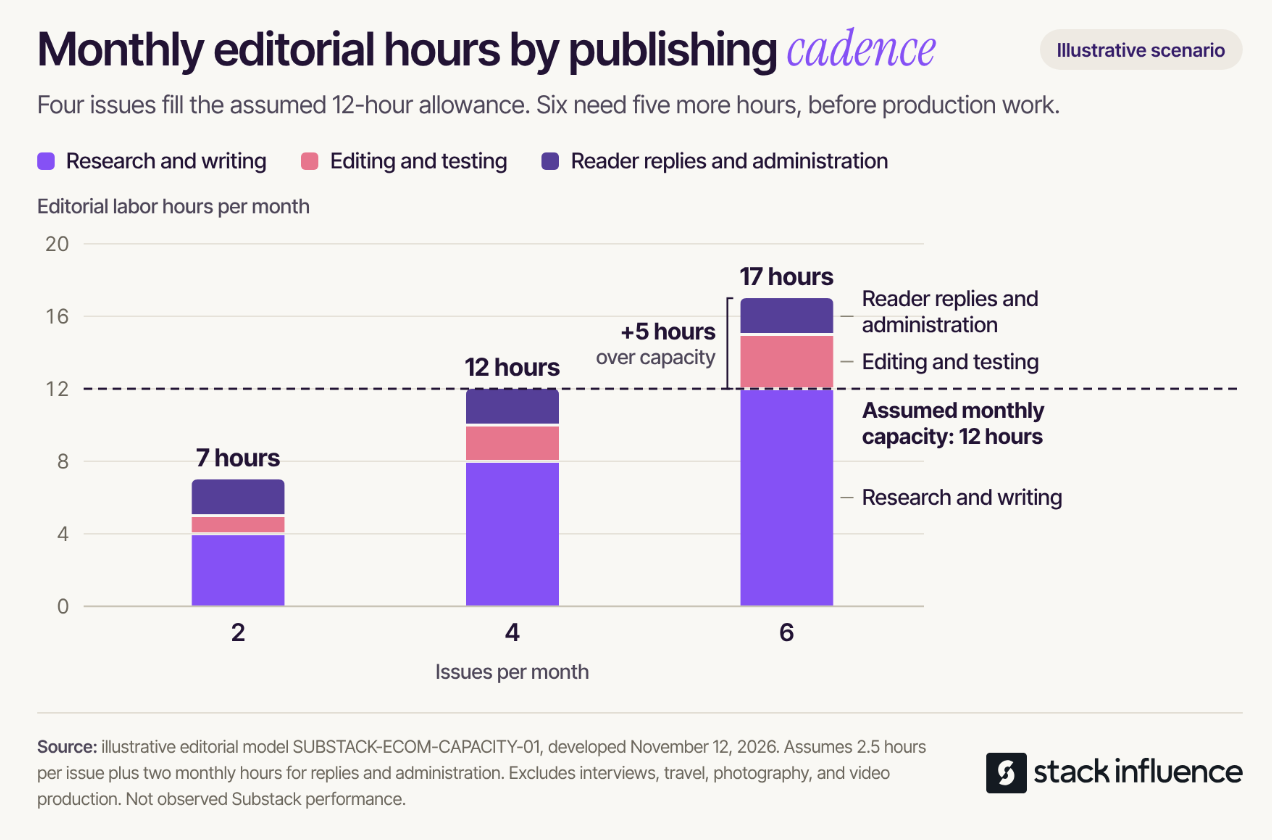
Consider this illustrative workload, created for planning rather than drawn from a benchmark: each issue takes two hours of research and writing plus half an hour of editing and testing. Reader replies and publication administration take another two hours per month.
- Two issues per month: Four hours of research and writing, one hour of editing and testing, and two hours of reader work, totaling seven hours.
- Four issues per month: Eight hours of research and writing, two hours of editing and testing, and two hours of reader work, totaling 12 hours.
- Six issues per month: Twelve hours of research and writing, three hours of editing and testing, and two hours of reader work, totaling 17 hours.
Under an assumed 12-hour monthly time allowance, four issues use the entire budget. Six require five additional hours. Interviews, travel, photography, and video production are excluded, so add them when your actual format requires them.
If you value the 12 hours at an illustrative $50 per hour, the four-issues-per-month scenario represents $600 of monthly editorial labor. This is a planning valuation, not a market rate or necessarily a new cash expense. Additional production, licensing, domain, or other publication costs would increase the budget.
Keep a new publication free while you establish what readers value, unless you have a separate, convincing paid editorial offer. Charging for a publication creates another product to deliver; it does not automatically make an ecommerce newsletter more valuable.
How to Launch a Focused Substack Pilot
Use a bounded pilot to test the publication's usefulness and your team's capacity. The following eight-week plan is an editorial recommendation, not a claim that eight weeks is enough to prove sales lift.
1. Write the Promise and Prepare the First Issues
Define the reader, the subject, and the expected cadence in one sentence. For the hypothetical ceramics brand, the promise might be: "A letter every other week about the craft, rituals, and practical decisions behind a well-used table."
Prepare four issue ideas before launch:
- A conversation with a home cook about making everyday dinners feel considered.
- A factual care guide that distinguishes the needs of different materials.
- A maker interview explaining a production decision and its tradeoffs.
- Answers to reader questions gathered from the earlier issues.
These are suggested topics, not examples of an observed brand campaign. Choose subjects your team can substantiate, and identify any expert input or photography needed before committing to the schedule.
2. Make Subscription a Clear Choice
Name the publication and explain its scope on the signup page. Invite interested customers through channels where you already have permission to contact them, or make the invitation visible on your website. Let the person choose to join.
Keep a record of what they signed up for and when. A store customer record, an order-notification address, and a publication subscription serve different purposes. Preserve unsubscribe records rather than merging lists indiscriminately.
In the welcome message, restate the promise, give the expected cadence, and invite a reply about the reader's interests. Substack's documented setup places these messages under Settings, then Emails. If you use Profile mode, welcome emails begin after at least two published posts; switching to the Custom theme removes that prerequisite. Test the applicable welcome message before inviting a larger audience.
3. Connect the Store Without Rebuilding It
Substack's navigation-bar instructions explicitly support an external shop link and state that Substack has no native merchandise-selling functionality.
To add that link, open your publication's Settings, find the Website section, and choose Add item under Navigation bar. Enter a clear title such as Shop and your store's destination URL, then select Add. Open the resulting link on desktop and mobile to verify that it reaches the intended page.
The external shop continues to handle the transaction. Place any product reference where it is relevant to the story, and make the destination clear to the reader.
4. Publish With a Useful Editorial Standard
Before sending an issue, check that it delivers the promised answer or story, supports factual claims, and works in an email preview. Open every destination link and review the mobile reading experience. A useful first issue gives people a reason to return; it should offer more than an announcement that the newsletter exists.
Creator contributions can add substance when they bring real experience. For the ceramics example, a cook could demonstrate a table-setting practice or explain how they use a particular piece. Obtain the permissions needed for the exact photos, quotations, and publication uses you intend.
If you already commission creator assets, review how repurposing creator content fits your publishing plan and the actual agreement. Treat a contributor's experience as their experience, and make any relevant commercial relationship clear.
5. Participate in the Publication's Subject Area
Use Substack Notes to share a useful excerpt, ask a specific question, or join a relevant discussion. Notes can reach the wider Substack network, but a new Note is not sent as a newsletter email; it may instead appear in a roundup or notification.
Substack also supports publication recommendations that appear in several discovery surfaces. Recommend publications because their work helps your readers, and approach potential collaborators with a concrete shared subject. A recommendation does not guarantee reciprocal promotion, new subscribers, or customers.
For the four-issue, eight-week pilot, schedule issues in weeks one, three, five, and seven. Keep notes on production time, reader questions, and what you would change. The aim is to learn whether the publication is worth continuing and whether its workload is sustainable.
How to Measure Value Without Confusing Readers With Customers

Keep a short publication record and a separate commerce record. This prevents a subscription gain from being reported as a customer gain.
For the publication, record new subscribers and unsubscribes over the same period, substantive replies or comments, recurring reader questions, and hours spent per issue. Use these observations to improve the subject matter and assess whether you can maintain it. A handful of enthusiastic replies is useful qualitative feedback, not proof of audience-wide demand.
For commerce, record identifiable visits from publication links, purchases attributed under your chosen reporting method, and contribution after variable costs. Compare equivalent periods and document the attribution window and model used by your reporting system.
Tag Relevant Links and Verify Purchase Tracking
Google's campaign URL guidance explains how UTM parameters identify referring campaigns in Google Analytics. An illustrative set of values for an emailed issue could be:
- utm_source=brand_publication
- utm_medium=email
- utm_campaign=table_care_issue
- utm_content=shop_link
Use consistent values and test that your analytics receives them. If the same tagged link appears in the public post, the app, or a forwarded email, the label does not prove where the reader encountered it.
Link tags do not install purchase tracking. Shopify's GA4 setup instructions explain the store connection and collection of ecommerce events. Verify your implementation before interpreting an absence of recorded orders as an absence of purchases.
Check the Economics With Contribution, Not Revenue
Use the separate four-issues-per-month scenario's $600 editorial budget as a financial screening example. This is a higher cadence than the suggested pilot. Assume no other publication costs for this calculation, and consider three hypothetical contributions per genuinely additional order:
- At $15 contribution per additional order, covering $600 requires 40 additional orders per month.
- At $20 contribution per additional order, covering $600 requires 30 additional orders per month.
- At $30 contribution per additional order, covering $600 requires 20 additional orders per month.
The calculation is monthly publication cost divided by contribution per additional order, rounded up when necessary. Here, contribution means revenue remaining after product cost, discounts, payment fees, variable fulfillment, and an allowance for returns. Fixed store overhead and any unspecified publication expenses are excluded.
These are planning thresholds, not expected conversion rates or Substack performance benchmarks. A lower contribution per order means more additional orders are needed to cover the same budget.
An attributed order is not necessarily an additional order. The buyer might have purchased anyway, encountered another campaign, or clicked a forwarded link. Use a suitable controlled comparison if you need evidence of incremental sales; the observational pilot described here does not establish it.
Decide What to Continue, Change, or Stop
Continue when the publication has a clear editorial purpose, readers show useful interest, and the workload fits a budget the business has deliberately approved. If reader feedback is promising but production is too heavy, narrow the format or reduce the cadence.
If the business case depends on additional sales, keep that requirement explicit and acknowledge when the available data cannot establish it. Reader relationships and customer learning can be worthwhile objectives, but they should not be relabeled as proven financial return.
Start With a Publication You Can Sustain
Choose a specific reader promise, prepare a small set of strong issues, and invite people to subscribe deliberately. Keep the store's operational responsibilities clear and set a realistic time budget before launch. Substack deserves a place in your ecommerce business when the publication provides lasting reader value and the commitment makes sense for your team.